My post the other day asked "Is Jazz Even Relevant?" This post was brought to you by my well documented depression. And now that I'm on the other side, I can answer that question.
It moves me. I listen to it and I want to play it. Nothing else I listen to these days does that for me. I still like the classic rock/metal of old, but very little of the new stuff strikes me as interesting. So, even if there's no one to hear me play, as long as I enjoy myself, that's what counts!
BTW - I thought briefly about just deleting that post, but it contained links to a couple of interesting articles, so I left it in tact.
Friday, May 30, 2008

Wednesday, May 28, 2008
Is Jazz Even Relevant?
Or is it the musical equivalent of taking Latin in school?
A recent article on jazz.com asked the question: Have bass solos ruined jazz? I found this article through a double bass player's email list. What surprised me most about the response was not "bass solos belong in jazz" or "jazz is not ruined", but "bass solos didn't ruin jazz...this did!" There were different theories on what ruined it and why it's no longer popular, mostly involving its evolution into something only other musicians can enjoy.
So why is it still played? Why do people study it in school?
Of course, the death of jazz does have its upside: Smooth Jazz RIP 1985 - 2008?
Friday, May 23, 2008
All That Jazz
I grew up listening to rock and, to a lesser extent, country. My dad liked Johnny Cash and my mom liked The Eagles. When I began to develop my own tastes in the mid '70s, I included such artists as Kiss, Queen, Elton John, Steve Miller Band, Cheap Trick, Van Halen, Alice Cooper. I did work backwards a little toward The Who and Led Zeppelin. As I grew older, my tastes grew heaver: AC/DC, Metallica, Anthrax, Iron Maiden.
Then, in the late '80s, I met a drummer named Jim Paxson. His mother is pianist Sunnie Paxson, who at one point played with Stanley Clarke. He pointed me to Return To Forever and Weather Report. This completely changed my playing and the way I listened to music. Bass playing became important, and not just a way to meet chicks.
It didn't take me too long to begin working backwards from fusion. I began to listen to more traditional jazz and really appreciate the sound of the upright. Meanwhile, I was a frustrated bass guitarist because I just couldn't find my role. I toyed with the fretless for a time and enjoyed it, but it still felt like something was missing. Plus, I was listening to less and less electric jazz.
Now I find myself totally immersed in "traditional" jazz: bebop, hard-bop, post-bop, modern. I find it to be the ultimate form of musical expression. Don't get me wrong, I still like rock - the heavier the better. Not overly fond of anything that's being released today, but that's probably because I'm old. Jazz, to me, has it all: emotion, musicianship, feeling, etc. Plus, the bass is not relegated to doubling the guitar.
So here's the problem I'm facing: I want to play jazz, but jazz is all but dead. Now that the Columbus Music Hall closed, there's nowhere left in Columbus to listen to good jazz on a regular basis. So, even if I do manage to ever learn to play it, I won't have anywhere to play.
Another issue is this: I'm 44 years old. My background in jazz is limited to the last 5 years or so. The upright bass is a completely different beast from the bass guitar. Playing jazz takes knowledge and courage. Can I play it? I'm signed up again for the Summer Jazz Workshop, but that doesn't help with the courage.
Playing with the orchestra does help. And I do enjoy it. But it's not my goal. Jazz is my goal. I just hope there are people who care to listen when I reach it.
Wednesday, April 30, 2008
Cardinal Health Chamber Orchestra Spring 2008 Performance Schedule
May 6 , 12 pm
Dublin Retirement Village
6470 Post Road Dublin, Oh
May 7, 7 pm
Dublin Scioto High School (FUNDRAISER)
4000 Hard Road, Dublin
May 9, 1 pm
Hilliard Senior Center
3800 Veterans Memorial Drive, Hilliard
May 13, 12 pm
Whetstone Garden of Roses
Hollerback Drive, Clintonville
May 15, 1 pm
Upper Arlington Senior Center
1945 Ridgeview Road, Columbus
May 17, 8 pm
Thank You Concert,
Church of Latter Day Saints
Coffman Road, Dublin
May 20, 1 pm
Trillium Place Retirement Center
Trillium Crossing
May 22, 1 pm
Abbey Theater at Dublin Recreation Center
5600 Post Road, Dublin
June 14, 7:30 pm
Union County Humane Society (FUNDRAISER)
Veterans Memorial Auditorium
233 W 6th Street
Marysville, OH
Thursday, March 06, 2008
Bow Adventures
I've been playing the double bass for about two years now. One aspect that has been a continuous struggle for me was the bow. You see, upon taking up the instrument, double bass players are immediately presented with a decision: French or German?
 The above image is from Bob Gollihur's excellent site, which includes an FAQ on bows.
For the first year of playing, I played with a French style bow because that's what my instructor used and that's what came with the bass. However, I was never able to get comfortable with it. I could not relax my grip enough to be effective. So, I decided to make the switch to German. I found an online source for quality, inexpensive bows in Upton Bass, and ordered their German style bow. Soon after, I joined the Cardinal Health Chamber Orchestra as second bassist. The principal bassist also played a German bow, and my instructor was able to give me some tips, so I felt fairly comfortable with my decision. I found the bow easier to hold, and it gave me a decent sound.
But there was still this nagging question: Is this really the right bow for me? I found the grip to be somewhat awkward, like I was also having to reach to play. And I always felt as if I were trying to cut down a tree with it. I would watch other German bow players, and they could produce such lovely sounds, yet I always sounded like a cow fighting a goose. My instructor, being a French bow player, could only help so much, and getting a new instructor was not an option because I really like him and his playing, and since my primary goal is to play jazz, he really is the right one for me.
Then I saw some instructional videos from Andrew Anderson. His grip on the French bow is very much like the grip of my instructor's. And after seeing how he placed his thumb and hearing his theories on grip and producing sound, I felt I had to give the French bow another chance. So, I ordered the French version of the Upton Bass bow.
I received the bow via UPS last Monday, and proceeded to work with it that evening. I was able to get decent sound from it, but it still felt uncomfortable, particularly when switching back and forth between the two. I was beginning to think I made a bad decision. But I knew I was not giving it a fair chance, and wanted to spend a week with it before deciding if I should keep it or not.
Tuesday was our next orchestra rehearsal, and while I toyed with the idea of bring the new French bow, I felt I was struggling enough with the music, so I brought my old one. Upon my arrival, I set up my music stand, got out my bow, tightened it up and hung it on the little hook on my music stand where I always hung my bow, got out my music and placed it on the stand. As I was leafing through the music to the first piece, the edge of my hand knocked the bow off of it's little hook and it hit tip-first onto the hard wood floor.

I had always heard that bows are fragile, particularly when under the stress of being tightened. At this point there wasn't much I could do, so without saying a word, I packed up my music stand and left rehearsal. Needless to say, I will not be hanging my bow in the music stand any longer.
Last night I played for quite some time with the French bow, and I found that without the option of switching back and forth, I was able to become much more comfortable with it. It'll take some work, but I think it'll pay off in the long run. Sometimes I need to have decisions made for me.
Wednesday, July 11, 2007
Jazz Camp Pictures
I put some pictures up. Use the link below to view them. I will add some more as soon as they're developed.
 |
| Summer Jazz Workshop 2007 |
Saturday, July 07, 2007
Summer Jazz Workshop
I'm back from the Summer Jazz Workshop. It was quite an amazing adventure.
Saturday, June 30:
My first day there. I came early for the Bass & Drum workshop before the week long Jazz workshop. They included guitar this year as well, basically to give rhythm section members a head start. I started the day with the audition, the purpose of which is to place the student in the correct level. Mine was a disaster. I was asked to play a standard blues in F, and I couldn't get through it without stopping to correct mistakes, which were many. After that mess, they placed the chord changes for Autumn Leaves in front of me and asked me to play. Fortunately, I have worked on this song in the past, so I wasn't completely lost. Bill Moring, one of the instructors who listened to my audition, assured me that I played some nice lines, learned from my mistakes and was in the right place.
After that, they divided us into groups. My group consisted of 5 bassists and about 12 guitarists. They put music in front of us and walked us through playing changes. After a couple of hours of that, they brought in a few drummers to play with us. We each took turns playing changes to the songs. We must have played through 10 standards that day. Unfortunately, I don't have a pick up installed on my bass, so I had to play that much harder to try to be loud enough to be heard. I had the makings of a nice blister by the end of the day.
That night, I went to a local club called The Jazz Factory to hear Jim Snidero, Lynn Seaton, Steve Allee and Steve Davis play. The first night of many great nights of jazz.
Sunday, July 1:
After taping my index finger to try to control my blister, it was another half day of playing standards with various drummers and guitarists. After Saturday, I was feeling pretty down. My playing was awful and didn't seem to be getting any better. The instructor was trying his best to help me out, telling me that the rhythm was more important than the notes and that bassists can get away with a good bit, so long as they do it in time. I, on the other hand, was questioning my ability to play jazz and even the upright itself.
After my last bass class, I completed my theory test (another aid in placing me), I had some dinner, did some shopping at the book/music store and went to the theater to hear some more great jazz. They divided various members of the faculty into 3 combos, who played from 7:30 - 10:30. Lynn Seaton did a fantastic bowed solo where he scatted his solo line as he played it. Very reminiscent of Slam Stewert.
Monday, July 2:
This was the first day of our full jazz workshop. The day was scheduled as: breakfast, theory class, ear training class, combo rehearsal, lunch, instrument master class, combo rehearsal, dinner, faculty concert. I was placed in the intermediate theory class, held by Dan Haerle. The first part of Bass Master Class was Rufus Reid and Lynn Seaton performing a duet, after which we were split into our various levels. I was assigned to Bass Lines 101, taught by various members of the faculty.
My combo was made up of two pianists (about my age), two guitarists (one teenager and one older), two sax players (13 and 17) and a drummer (also 17). The drummer was very, very new to jazz and didn't really have a clue of what to do. Fortunately for me, his instructor was Steve Davis, who asked to play a few choruses of "Take the 'A' Train" with me to show him. That was a nice way to start my combo experience. We spent both of our rehearsals just running through various standards, getting a feel for each other. This was the first time I actually felt comfortable with my playing.
The concert was another amazing time. I could tell already that each concert was bound to out-do the previous.
Tuesday & Wednesday July 3-4:
While Monday's theory class was mostly review for me, Tuesday immediately moved into unknown territory. The classes dealt mostly with identifying which scales work best over which chords. We also worked a lot on recognizing ii-V-I progressions in major and minor and how to play over the changes.
Ear training was with Jamey Aebersold himself. We spent time listening to various tunes and while Jamey would show the transcription on an overhead. Then, he would go to the piano and test us on identifying major and minor chords as he played. I used to think I was pretty good at this, but clearly I have some work to do.
For combo, we usually spent each session working on a couple of songs. We played with the arrangement a bit, adding shout choruses and trading fours (band plays 4 bars, drummer plays 4 bars). I could feel myself getting more comfortable with my playing as the days went on. Solos were still giving me fits, but at least I was no longer panicking when it was my turn.
Bass master class dealt mostly with creating bass lines to fit the chord changes. At this point, I had already discovered most of what they were teaching, but it was nice to have the confirmation.
The faculty concerts were amazing. They were all really great players, and some of them would just knock your doors off every time they took the stage:
This was the money day. Since Friday was going to be spent preparing for combo performance, this was the last day to get real information. And for me, that moment was when our combo's rhythm section played with a couple members of the faculty. Every day, rhythm and horn sections were selected to play with faculty members, and this was our day. I showed up, nervous and excited, wondering who we'd be playing with, when in walks Antonio Hart and Shelley Yoelin. To my great delight, Antonio worked very closely with the drummer and me, helping us to get a tight sound. He gave me some very good advise on time and rhythm.
In our afternoon combo rehearsal, we voted on our song for the Friday performance: Blue Bossa.
Friday, July 6:
The big day! Bass master class featured three duets performed by students selected earlier in the week followed by an 11 bass blues jam by all of the bass faculty. Our last combo rehearsal was spent working on our Blue Bossa arrangement. We worked out an intro with syncopated rhythms, everyone taking two choruses for their solos except me; I managed to talk myself down to one chorus.
Our performance was scheduled for 2:40, so after lunch I sat and watched some of the other combo performances. A half hour before our performance, I met the rest of the combo back stage. Before I knew it, it was time to go on - no time for nervousness. The drummer and I started the intro, but one of the sax players started right in on the melody. Oh well, the rest of us followed and no one was the wiser. As the song went on, it was interesting to hear the applause between the solos - quite exciting actually. Then it was time for my solo. I had worked out some of it before hand, being sure not to write the whole thing so that I'd be forced to improvise some of it. The chorus was over before I knew it and I started to play the last chorus. Unfortunately, the sax players didn't follow suit. I figured they forgot I was only taking one chorus, so I started soloing some more. Half way through my solo, the sax players caught their mistake and started playing the head - right in the middle of the second chorus. Oh well, the rest of us picked up on it, played the head and finished the song. That's jazz, right?
Wrap-up:
Despite my early anxiety and depression (not to mention the massive blisters on my fingers), the week was a truly wonderful experience. I think with a lot of work, I might actually be able to do this thing.
Pictures will be posted soon.
Saturday, June 30:
My first day there. I came early for the Bass & Drum workshop before the week long Jazz workshop. They included guitar this year as well, basically to give rhythm section members a head start. I started the day with the audition, the purpose of which is to place the student in the correct level. Mine was a disaster. I was asked to play a standard blues in F, and I couldn't get through it without stopping to correct mistakes, which were many. After that mess, they placed the chord changes for Autumn Leaves in front of me and asked me to play. Fortunately, I have worked on this song in the past, so I wasn't completely lost. Bill Moring, one of the instructors who listened to my audition, assured me that I played some nice lines, learned from my mistakes and was in the right place.
After that, they divided us into groups. My group consisted of 5 bassists and about 12 guitarists. They put music in front of us and walked us through playing changes. After a couple of hours of that, they brought in a few drummers to play with us. We each took turns playing changes to the songs. We must have played through 10 standards that day. Unfortunately, I don't have a pick up installed on my bass, so I had to play that much harder to try to be loud enough to be heard. I had the makings of a nice blister by the end of the day.
That night, I went to a local club called The Jazz Factory to hear Jim Snidero, Lynn Seaton, Steve Allee and Steve Davis play. The first night of many great nights of jazz.
Sunday, July 1:
After taping my index finger to try to control my blister, it was another half day of playing standards with various drummers and guitarists. After Saturday, I was feeling pretty down. My playing was awful and didn't seem to be getting any better. The instructor was trying his best to help me out, telling me that the rhythm was more important than the notes and that bassists can get away with a good bit, so long as they do it in time. I, on the other hand, was questioning my ability to play jazz and even the upright itself.
After my last bass class, I completed my theory test (another aid in placing me), I had some dinner, did some shopping at the book/music store and went to the theater to hear some more great jazz. They divided various members of the faculty into 3 combos, who played from 7:30 - 10:30. Lynn Seaton did a fantastic bowed solo where he scatted his solo line as he played it. Very reminiscent of Slam Stewert.
Monday, July 2:
This was the first day of our full jazz workshop. The day was scheduled as: breakfast, theory class, ear training class, combo rehearsal, lunch, instrument master class, combo rehearsal, dinner, faculty concert. I was placed in the intermediate theory class, held by Dan Haerle. The first part of Bass Master Class was Rufus Reid and Lynn Seaton performing a duet, after which we were split into our various levels. I was assigned to Bass Lines 101, taught by various members of the faculty.
My combo was made up of two pianists (about my age), two guitarists (one teenager and one older), two sax players (13 and 17) and a drummer (also 17). The drummer was very, very new to jazz and didn't really have a clue of what to do. Fortunately for me, his instructor was Steve Davis, who asked to play a few choruses of "Take the 'A' Train" with me to show him. That was a nice way to start my combo experience. We spent both of our rehearsals just running through various standards, getting a feel for each other. This was the first time I actually felt comfortable with my playing.
The concert was another amazing time. I could tell already that each concert was bound to out-do the previous.
Tuesday & Wednesday July 3-4:
While Monday's theory class was mostly review for me, Tuesday immediately moved into unknown territory. The classes dealt mostly with identifying which scales work best over which chords. We also worked a lot on recognizing ii-V-I progressions in major and minor and how to play over the changes.
Ear training was with Jamey Aebersold himself. We spent time listening to various tunes and while Jamey would show the transcription on an overhead. Then, he would go to the piano and test us on identifying major and minor chords as he played. I used to think I was pretty good at this, but clearly I have some work to do.
For combo, we usually spent each session working on a couple of songs. We played with the arrangement a bit, adding shout choruses and trading fours (band plays 4 bars, drummer plays 4 bars). I could feel myself getting more comfortable with my playing as the days went on. Solos were still giving me fits, but at least I was no longer panicking when it was my turn.
Bass master class dealt mostly with creating bass lines to fit the chord changes. At this point, I had already discovered most of what they were teaching, but it was nice to have the confirmation.
The faculty concerts were amazing. They were all really great players, and some of them would just knock your doors off every time they took the stage:
- Antonio Hart is simply and amazing sax player. He never ceased to amaze.
- Jim Rotondi is a fantastic trumpet player
- Rufus Reid is the definition of cool
- Lynn Seaton constantly made my jaw hit the floor
- Steve Davis uses every inch of a drum kit and never misses a beat
This was the money day. Since Friday was going to be spent preparing for combo performance, this was the last day to get real information. And for me, that moment was when our combo's rhythm section played with a couple members of the faculty. Every day, rhythm and horn sections were selected to play with faculty members, and this was our day. I showed up, nervous and excited, wondering who we'd be playing with, when in walks Antonio Hart and Shelley Yoelin. To my great delight, Antonio worked very closely with the drummer and me, helping us to get a tight sound. He gave me some very good advise on time and rhythm.
In our afternoon combo rehearsal, we voted on our song for the Friday performance: Blue Bossa.
Friday, July 6:
The big day! Bass master class featured three duets performed by students selected earlier in the week followed by an 11 bass blues jam by all of the bass faculty. Our last combo rehearsal was spent working on our Blue Bossa arrangement. We worked out an intro with syncopated rhythms, everyone taking two choruses for their solos except me; I managed to talk myself down to one chorus.
Our performance was scheduled for 2:40, so after lunch I sat and watched some of the other combo performances. A half hour before our performance, I met the rest of the combo back stage. Before I knew it, it was time to go on - no time for nervousness. The drummer and I started the intro, but one of the sax players started right in on the melody. Oh well, the rest of us followed and no one was the wiser. As the song went on, it was interesting to hear the applause between the solos - quite exciting actually. Then it was time for my solo. I had worked out some of it before hand, being sure not to write the whole thing so that I'd be forced to improvise some of it. The chorus was over before I knew it and I started to play the last chorus. Unfortunately, the sax players didn't follow suit. I figured they forgot I was only taking one chorus, so I started soloing some more. Half way through my solo, the sax players caught their mistake and started playing the head - right in the middle of the second chorus. Oh well, the rest of us picked up on it, played the head and finished the song. That's jazz, right?
Wrap-up:
Despite my early anxiety and depression (not to mention the massive blisters on my fingers), the week was a truly wonderful experience. I think with a lot of work, I might actually be able to do this thing.
Pictures will be posted soon.
Monday, January 29, 2007
CAH Chamber Orchestra Performance Schedule
The Spring 2007 performance schedule for the Cardinal Health Chamber Orchestra was just released. Here are the dates and locales:
- 05/01 12:00 PM - Dublin Retirement Village
- 05/03 1:45 PM - Norwich Elementary School
- 05/08 12:45 PM - Gillie Senior Center
- 05/10 1:00 PM - Martin Janis Senior Center
- 05/15 1:00 PM - Wexner Heritage Center
- 05/17 1:30 PM - Trillium Place
- 05/22 12:00 PM - Cardinal Health
- 05/23 1:30 PM - Abbey Theater
- 05/24 1:30 PM - Abbey Theater
Friday, January 12, 2007
New Music Endeavors
I found a new band...The Intolerables! They're not looking to play out, just record, which is fine by me. They have their own studio, so I'll be recording there as well as swapping files from home.
I played with them for the first time last Thursday (01/04). There are lots of different influences, and it was very laid back. Very cool. We practice in the studio with the drums mic'ed in a separate room and all of us going into the board and wearing phones. Nice set-up.
In other music news, my workplace sponsors a volunteer chamber orchestra, for which I signed up to play. I have my first practice next Friday (01/19). This should be interesting. Being new to the double bass and to orchestra playing, it'll be quite a challenge.
And lastly, I'm signing up to go to a Summer Jazz Workshop. A full week of studying bass and jazz, culminating with a performance with a group in front of the other attendees, the teachers and family.
Experience has taught me that I won't practice unless I'm under pressure to do so. So I'm applying some pressure.
Please note too that I put a schedule of my music events at the bottom of the blog (scroll down). This will include practice and recording sessions, scheduled lessons and performances. I will include addresses and contact information where applicable.
Sunday, July 16, 2006
Olivia's Piano Recital
My youngest started piano lessons last February and has been doing great. She loves it! Her first piano recital was June, 17th, in which she played "Sugarfoot Rag" as a duet with her teacher. About half way through the piece she lost her place and tried to pick up where she left off, but thankfully her teacher suggested they start over. She made it through the piece beautifully, took her bow to thunderous applause and Tammy and I were able to resume our breathing.
Here is a video of her performance. The MPEG is just over 15 meg, so you might not want to retrieve it using dial-up.
Here is a video of her performance. The MPEG is just over 15 meg, so you might not want to retrieve it using dial-up.
Wednesday, July 05, 2006
Fly
The Great Javelin Experiment is complete and we have a new song: Fly (click to download). This song started with Matt Butler recording some guitar and passing it on to me. I added bass and forwarded it to Jeff Thinschmidt who worked his magic by completely rearranging the song and adding a drum track. Dennis Haberkern added guitar, Matt added some synth guitar, Mel Scott added vocals with Jeff and Matt providing back-ups along with a female barbershop quartet doing harmony. Then, after many painstaking hours spent by Jeff mixing the song, we have the finish product.
This was really an interesting experiment in that, once each of us were done with our piece, we passed it on and didn't have any more input until the end, so each of us built on what the person before us provided. And all of this was done without any of us being in the same room at any given time. Pretty cool.
This was really an interesting experiment in that, once each of us were done with our piece, we passed it on and didn't have any more input until the end, so each of us built on what the person before us provided. And all of this was done without any of us being in the same room at any given time. Pretty cool.
Monday, July 03, 2006
Van Howard
 My youngest, Olivia, has always wanted to play drums. We convinced her that it would be better for her to take piano lessons first, as piano would give her a good all-around understanding of music.
Well, she's been playing piano for about 4 months now and is doing very well. We never have to remind her to practice and she really enjoys it. But she still would talk about how much she wanted to play the drums. This talk was fueled by the fact that a local music store where Lea takes guitar lessons had a used Pearl set for sale.
After some discussion, we told her we'd meet her 1/2 way on the purchase of the drum set. Little did we know she already had enough saved up to pay her portion. So now she is taking drum lessons in addition to piano lessons and our "music" room no longer has space for seating.
Sunday, April 23, 2006
First Lesson
Well, I had my first double bass lesson yesterday. My instructor's name is Doug Richeson (for those interested, here's his bio).
I was very nervous before my lesson. I haven't been in a lesson situation for probably 20 years! I had my bass packed and ready to go a full 3 hours before my lesson, just in case (of what, I don't know).
The lesson took place in his studio at Denison University. There was a soap-box derby race going on in front of the building, so they had the street blocked off. As such, I had to park a block and a half away. My first lesson - even though the bass is hollow, it's heavy!
Doug was very cool. We spent the first 15 minutes going over my left hand technique (wrong!) and my right hand pizzicato (plucking) technique (also wrong!). Then we immediately started talking about theory and improvising walking bass lines. I've never been good at walking bass lines - I just can't seem to think fast enough - but I remind myself that's why I'm taking lessons. And if I want to play jazz, I'd better learn.
My first big test came when he placed a chord chart in front of me for a standard 12 bar blues and put on a play-along CD. I had to try to play a walking line with chord tones, using leading and passing tones on the fourth beat of every measure. When it was over, I had old B&W movie footage of a war-time plane, flames shooting out of the tail, spinning wildly as it crashed into the ocean, going through my head. Then my instructor said "Good. You'll get this in no time." That's when I noticed the pilot floating gently down with his parachute.
After we talked about theory some more and he outlined my study material, we talked about my right hand arco (bowing) technique (wrong!).
Needless to say, I have a lot of work ahead of me. But it's good work. And I feel good about it. I went into my lesson wondering if this is something I'd be able to pull off, or if I was just wasting my time...too old and too set in my ways to learn something new. Now my only concern is finding enough time to practice.
An interesting sidenote: when he asked me to name some of my favorite bassists, two at the top of my list were Charles Mingus and Paul Chambers...and unbeknownst to me, yesterday was their birthday.
Thursday, February 16, 2006
Now THIS is a Bass!
 I've always wanted one of these, but never had a real reason to get one. But I've found myself listening to a lot of traditional jazz the last couple of years, and so I thought I'd give it a shot.
It's quite a different animal from the bass guitar, even the fretless. But I'm enjoying myself a great deal as I work around the fingerboard, trying to find my notes. I got a bow with it, and I am trying to work with that too, but it still sounds very much like a sick cow when I use it.
Right now I'm working with a book that I used to use during bass lessons in the 80's - The Evolving Bassist by Rufus Reid. It's a very good book, and he included fingering and bowing instructions with the excersizes. Still I may have to spring for lessons to make sure I'm doing it right. I wouldn't hurt to have some direction too.
My plan is to keep renting this for a while until I decide it's for me. The shop I'm renting it from has a nice policy where 100% of the rental fee gets applied to purchase should I decide to buy one later. I'd like to get a hybrid (solid top, ply sides) or, if I can afford one, a carved bass. But that's in the future. Right now I just need to figure out how to play in tune.
Sunday, January 29, 2006
New Guitar in the Family
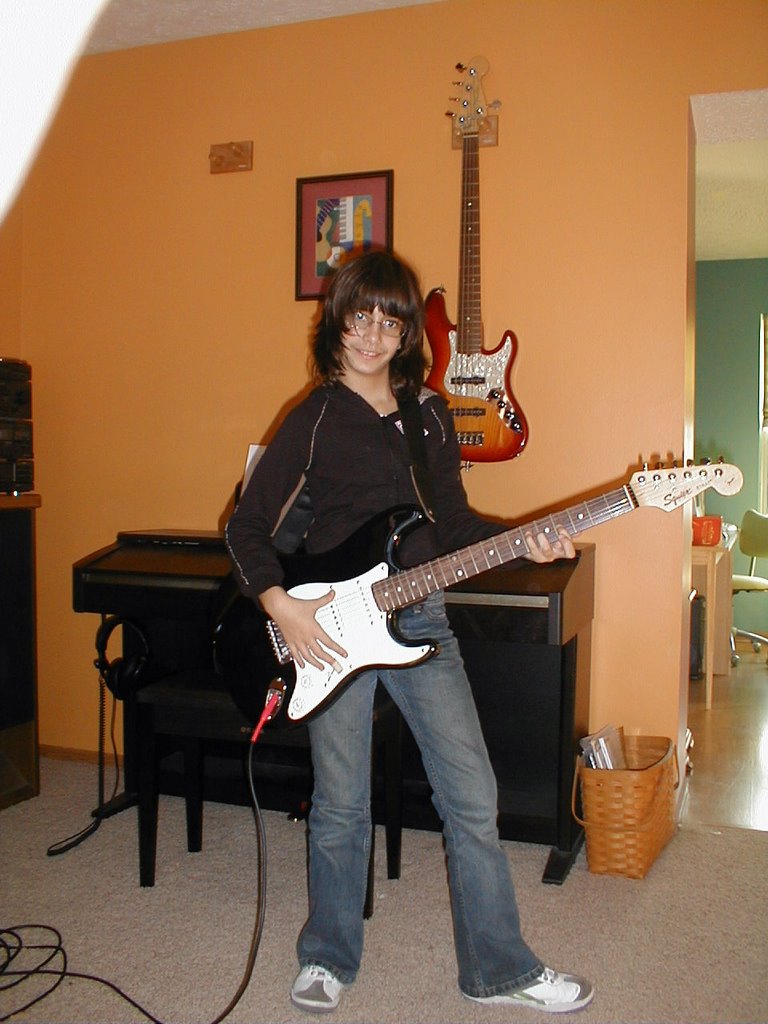
My oldest daughter Lea saved up her own money and bought herself a guitar. It's a Squire Stratocaster. She named it Bebe.
She's really quite proud of it, and I'm proud of her for saving enough money to purchase it. I didn't want her to buy the first one she saw...I wanted to make sure she got one that wouldn't be an exercise in frustration every time she played it. I think she made a good choice.
Sunday, January 08, 2006
Fayde - Part 2
Exit Zack Bocelle, enter Wayne Camp.
I had worked with Wayne in Rekkless for a couple of years, so he and I were already pretty good friends. And again we went to a pretty serious practice schedule, getting together 4 or 5 nights a week for a minimum of 3 hours each night. Most of these sessions were fueled by gallon jugs of Earnest & Julio Gallo Chablis.
After a good bit of practice, we were finally able to play out. Most of our shows were at Reds in Margate, NJ and we managed to gather a decent following. We also sponsored our own show at the Music Pier in Ocean City, NJ. We picked a charity for the proceeds, printed the tickets and sold them ourselves. We also built a pretty cool stage, with ramps on both sides of the drum riser going up to a platform that ran behind the drummer. The show was a great success, with every seat being occupied. The show went off without a hitch as well, which was pretty cool seeing as we were still building the drum riser two hours before the show.
As things progressed with the band, we started talking about taking things to the next level. We went back to the studio and recorded two more songs with Wayne on vocals (Turn Me Loose and Shoot You) and made plans to move the band to the west coast.
Each of us left at different times, with plans to meet in Los Angeles. Jim went out early and arranged for apartments for us in a building that was currently being built just off of Hollywood Boulevard. Pete Manno and I were going to be living together, so I sent money ahead to hold the apartment for us. And then I rented a U-Haul trailer, packed up all my belongings, set on my way.
Unfortunately, the band was pretty much broken up before I even got out there. There were arguments and broken property and that was it. Of course, I couldn't turn around and go back, so I arrived in L.A. on September 31, 1987. The apartment wasn't finished yet, so I rented a room in a motel right next door and settled in.
The next morning, as I was moving my truck from one side of the street to the other, I noticed the glass front of the motel start to wobble, followed by some very loud and very scary rumblings. My first 24 hours in L.A. were greeted by an earthquake measuring 5.9.
I didn't turn around right away, though the aftershocks were a good bit less than fun. But, unable to find a job and with no band to keep me there, I left about a month later. I didn't have the funds to rent another trailer to take my stuff back, so I had to pare everything down to whatever would fit in the back of the pick-up.
Friday, December 23, 2005
Fayde - Part 1
Pete Manno and Robin Russo were both guitarists for Sacred Sword at different times. I knew Pete from working at the parking lot, and when he and Robin decided to put a band together, they asked me to play bass.
They were both very good guitar players, and both very different. Pete was technical, where Robin played more by feel. They complimented each other well.
On drums, they got Jim Paxson. Jim was, and still is, one of the best drummers I ever played with. His father was a drummer in a casino band at the time, and his mother is Sunnie Paxson, a jazz keyboardist who once recorded and played with Stanley Clarke. Jim is responsible for introducing me to jazz fusion, which would ultimately become my favorite form of music and would drastically change my playing style.
First up on vocals was Zack Bocelle, an excellent singer who I would end up working with more later.
The 5 of us practiced every night writing new material, and Jim set up a recording session for us in North Jersey. None of our songs had vocals yet, but still the date was set. So, after working a full day at the parking lot, I picked Zack up and the two of us set off in my truck for the two-hour drive to the studio. Zack had a cassette from one of our practices, so we just played that over and over so that he could write lyrics to the two songs we were recording. They ended up being Gettin' Ready and I'll Be Back Again.
The studio itself was at the top of this run-down office building. The accoustics were terrible. During recording of the rhythm track, I unveiled my new bass line for the break in Gettin' Ready. I knew it needed something, so I worked on it the night before, to be ready for the recording. Everyone was very happy with what I was playing, so after we finished up the rhythm track and some of the guitar work, I went into the hall and fell asleep on the floor for a couple of hours.
At about 2:00 am, Pete woke me up, excited with the vocals that Zack layed down, so I watched him and Robin do their guitar solos. We mixed it all down and left the studio just in time for me to go to work the next morning for my shift the following day. In all, I'm fairly happy with the recording. It was a rush job, so there are quite a few mistakes on it, and you can barely hear the bass line in the break I worked so hard on, but they're good songs.
In the end, though, Zack and Pete just couldn't make it work, and so Zack left (or was asked to leave, not sure) the band.
Tuesday, December 20, 2005
Nitro
Nitro was really more of an idea than a band. Jerry Johnson was a guitarist for the local heavy metal band Sacred Sword who wanted to form a band of his own. He asked Joe Lamaina and me to join up with him to form Nitro. Jerry was probably best known for attaching a cheese grater to the back of his guitar and punching it during his guitar solo to make his knuckles bleed while he played. He reminded me very much of Blackie Lawless from W.A.S.P.
We played a few times together, writing songs and jamming, but didn't have a singer. Still, that didn't stop us from booking studio time in the same Northfield studio Rekkless recorded in earlier. For vocals, Jerry got Ted Ellis from another local band Altoona Works to sit in. He sat in the engineers booth while the three of us recorded the rhythm tracks, listening to the song and writing lyrics.
When it came time for the vocals, I got my first real lesson in the "magic" of the studio. While Ted had a good, powerful voice, he was unable to sing more than two lines of the song in a row. So the engineer had him record two lines, stop the tape, back-up a little and record the next two lines. This was done for the entire song. Still, Demons Cry is a pretty cool song and we had a lot of fun recording it.
Things fell apart pretty quickly after that though. Shortly after we finished the song, Jerry set up a radio interview for the band. Unfortunately, he failed to check with us first on the date. I had already scheduled a trip to visit family. So, while I was away, Jerry and Joe did the radio interview and played the song on the air. My apparent punishment for failure to appear on the radio show was to have Jerry forget to mention my name as a member of the band.
Needless to say, that was it for me.
Sunday, December 18, 2005
A Sideman's Journey

I finally put the finishing touches on my CD today. This CD represents 8 very active years recording and playing in bands between 1984 and 1992. The song list is as follows:
- Little Killer - Rekkless
- Get Ready - Rekkless
- Lucky 7 - Rekkless
- We Like It Hot - Rekkless
- Demons Cry - Nitro
- Never Look Back - Tom Howard
- Gettin' Ready - Fayde
- I'll Be Back Again - Fayde
- Turn Me Loose - Fayde
- Shoot You - Fayde
- Don't Tease Me - Jinxx
- Jennifer - Jinxx
- Carnival - Craig Koons and Tom Howard
- Back In The Swing - Hard Knox
- To The Heavens - Rhythm Tribe
- Walkin' Over - Rhythm Tribe
- Can't Absorb The Madness - Vince Valore
- Remember Her - Tom Howard
Tuesday, November 15, 2005
Rekkless
 This was my first serious band since Javelin. It featured Wayne Camp on vocals, Craig Koons on guitar, Joe Lamaina on drums and me on bass. We started out playing cover tunes (hair-metal bands of the day: Motley Crue, Ratt, Ozzy, Kiss) and had one original song, Little Killer.
This was the first band I was in that recorded at a recording studio; not once, but twice. Our first time in the studio was this place in Pleasantville, NJ, that used to be a church. We recorded "Smokin' in the Boy's Room", "Little Killer", "Rock and Roll All Night" and "Helter Skelter". This being our first time in the studio, we were pretty much at the mercy of the guys at the mixing board. All in all, it was a good experience.
Our second time in the studio was probably a year later. Our manager, Mike Turron, found a guy in Northfield who actually built a recording studio onto the back of his house. He really went all out with it too. I remember the first time we went there, walking around, amazed at how the walls just soaked up sound so there was no echo. This was nothing like the church. We re-recorded "Little Killer" along with four other originals: "Get Ready", "Just Call Me", "Lucky 7" and the blues inspired "We Like It Hot." The owner of the studio was still learning the art of mixing, as were we, so it still didn't sound great. I would work with him several more times over the years though, and each time got better.
In addition to recording, we managed to do a lot of playing out. Our first real gig was openning for local heavy metal band Sacred Sword at Blondie's night club. Craig was still in high-school at the time, so we actually had to get his mom to sign a paper giving him permission to play in a bar. Since this was the first time I had played in front of a crowd in a long time, I can still remember how much my hands were shaking through the entire performance. I still don't know how I managed to work my way through it.
We played a lot of gigs as a band: we played at The Omni when it first openned, we played 3 gigs at the bar at the base of the Somers Point-Longport bridge, we played several parties and city events throughout south Jersey, and we even sponsored a show in Stone Harbor that drew a pretty good crowd. We had t-shirts made up that sold pretty well at shows, too. Enough that we actually had to have a second printing 'cause we ran out of the first batch.
Our last show as a band was a self sponsored booze-cruise in Brigantine Harbor. We weren't allowed to stay in the harbor because we were too loud, so they took us out on the ocean where the waves caused the boat to rock back and forth, knocking our equipment over. It was a very good show, though. The evening took a tragic turn when one of our roadies was killed in a hit-and-run accident while walking down the road sometime after the show was over. It also happened to be my birthday.
Subscribe to:
Posts (Atom)
